 LEN
“My doctor told me to stop squatting.” I hear this all the time from patients with patellofemoral pain. And I get why. The knee hurts when they squat, so just stop squatting, right?
Not so fast.
We tackled this on a recent episode of the Ask Mike Reinold Podcast. Sarah from Nashville asked a great question. Her patient with patellofemoral pain has pain when squatting, and the physician wants them to stop all squats. Should she stop them, modify them, or keep going? Is she being too cautious or too aggressive?
Short answer: when it comes to squatting with patellofemoral pain, modify before you stop. Stopping everything is rarely the right first move.
I mostly sat back and listened on this one, because my coworkers nailed it. Here’s a recap of what Mike, Dave Tilley, Kevin Coughlin and Diwesh Poudyal covered, plus a few of my own thoughts.
You can’t avoid squatting
Dave made a great point right off the bat. You squat every single day. You squat to sit in a chair, to go to the bathroom and to pick something up off the floor. So telling someone to “stop squatting” doesn’t really make sense.
What we’re really talking about is squatting as an exercise, and how much load we put through the knee with it. That’s a different conversation.
Patellofemoral pain also comes in a lot of flavors. If the knee is really cranky and irritable, you may need to back off for a bit to calm it down. But eventually that tissue needs load to adapt and get less sensitive. Taking load away forever doesn’t get you there.
Mike also brought up something I see all the time. Once a patient is told squatting caused their pain, they start to fear it. Then every squat feels dangerous. That fear can stick around a lot longer than the pain does.
Not all squats are the same
“There’s no such thing as a bad squat” is something you hear a lot on social media. Mike disagreed, and so do I. There are better and worse squats for a specific knee at a specific time.
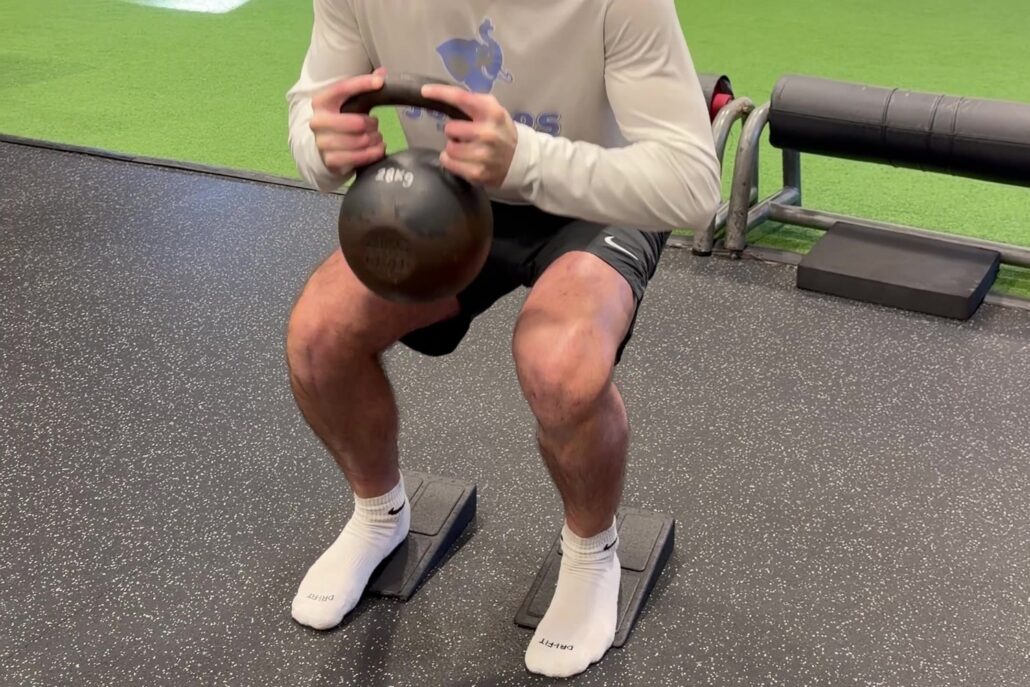
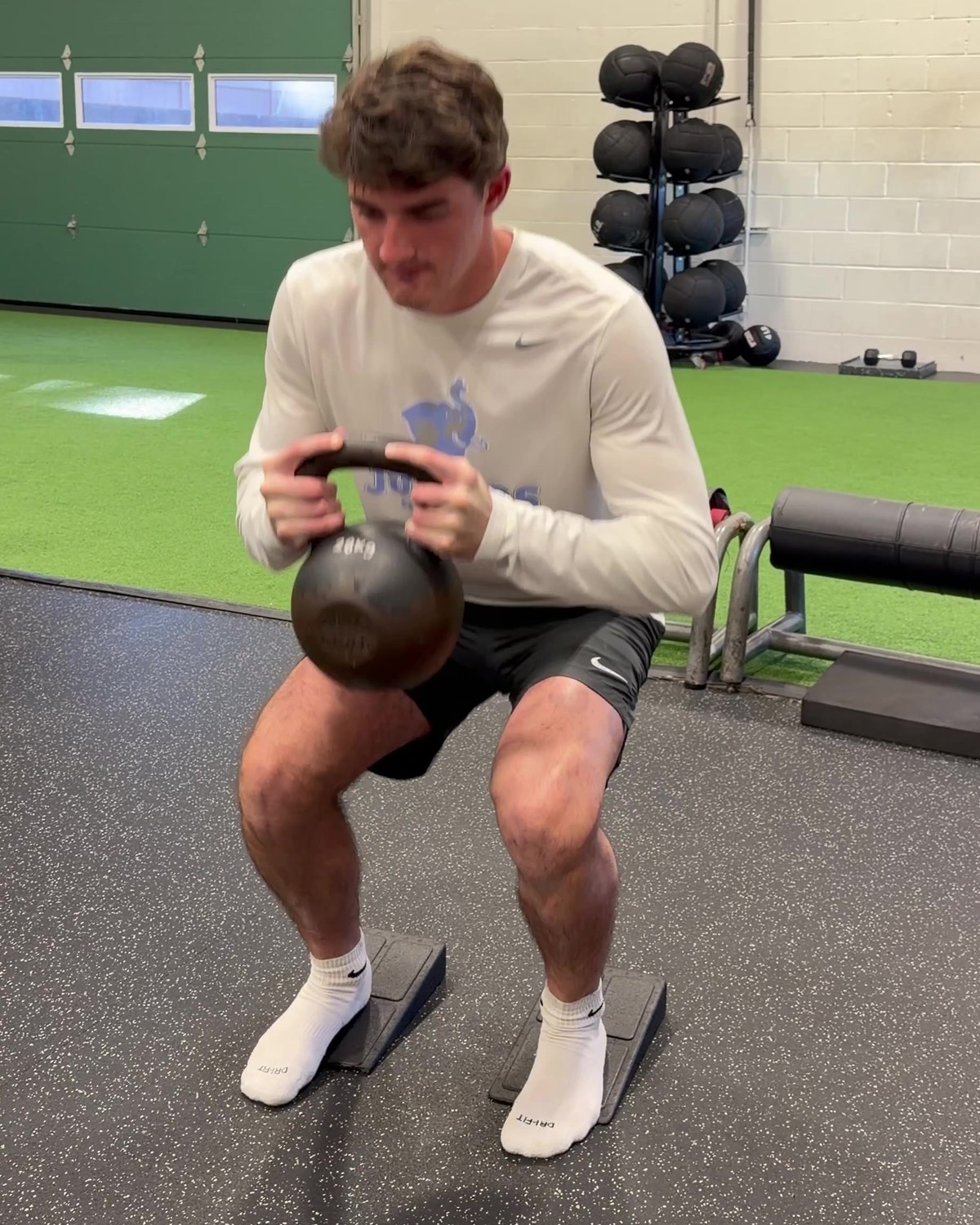
Dave described squats as a spectrum. On one end you have very knee dominant squats, like a slant board squat or a sissy squat. On the other end you have hip dominant squats, like a low bar box squat. Front squats and cleans sit closer to the knee end and load the patellofemoral joint a lot. A low bar box squat or a power clean can be a nice temporary swap for an athlete who still wants to train.
And don’t forget to look above and below the knee. Limited ankle mobility, hip issues and how someone moves can all play a role. All of that needs to be considered in someone with patellofemoral pain.
What the biomechanics tell us
Kevin broke down the science. In a squat, the deeper you go, the more contact and stress you get at the patellofemoral joint. Add load and it goes up even more. This paper by Wallace and Powers showed exactly that, with patellofemoral stress climbing as the knee bent toward 90 degrees and climbing more when people held weight. An older paper out of ASMI with my friends Kevin Wilk and Glenn Fleisig found the same thing, with patellofemoral force highest near full flexion in the squat and leg press.
So you have two easy variables to manipulate: range and load. Squat to a box that limits depth or lighten the weight.
Open chain is the opposite. Knee extension tends to be better tolerated from about 90 down to 45 degrees and gets tougher as you get close to full extension. Knowing that lets you strengthen the quad without making things worse. Isometrics at various ranges of motion can also be friendly to the anterior knee.
Kevin also gave a third option that I really like. Keep the same squat but slow it down. A slower tempo makes the exercise harder without adding weight or depth.
Small cues matter too. A 2025 study found that just cueing people to keep their weight a little more forward on their feet lowered patellofemoral stress by about 9% during a bodyweight squat, and they didn’t have to lean their trunk forward to do it.
Kevin also mentioned McConnell taping and foot orthoses as short term tools to calm symptoms down. Those line up with the 2016 patellofemoral pain consensus statement, which recommends exercise therapy, especially hip and knee exercises together, with taping and foot orthoses as short term helpers.
Want to see how I put all of this together for the knee? Mike Reinold and I teach it step by step in our online course, Complete Knee Evaluation and Treatment.
Check out the course →How Diwesh progresses squats
This was my favorite part of the episode. Diwesh walked through how he actually does it in the gym with his fitness clients and some of our PT clients.
He starts with small changes before big ones. Cues, where the weight is held, stance width, hip versus knee emphasis and how the knee tracks. For a goblet squat, that might mean holding the weight closer to the body, sitting the hips back a bit, widening the stance or pushing the knees out.
Then he checks pain. If pain is around a 1 or 2 out of 10 and stays there through the set and across sets, that’s usually fine. If someone starts at a 5 or 6 out of 10, he keeps adjusting until that number comes down.
If small changes don’t do it, he makes bigger ones. Something like this:
- Low bar box squat, limiting depth if needed
- Low bar back squat
- High bar back squat
- Front squat to full depth
The goal is to strain the tissue enough to adapt, not to keep poking the bear. If you go a little backwards one week, that’s ok. Just adjust and keep moving.
My thoughts
This lines up with how I treat patellofemoral pain at Champion. I rarely take squats away completely. I change them. Box squats, tempo squats, goblet squats with good cues, whatever the knee will tolerate that day.
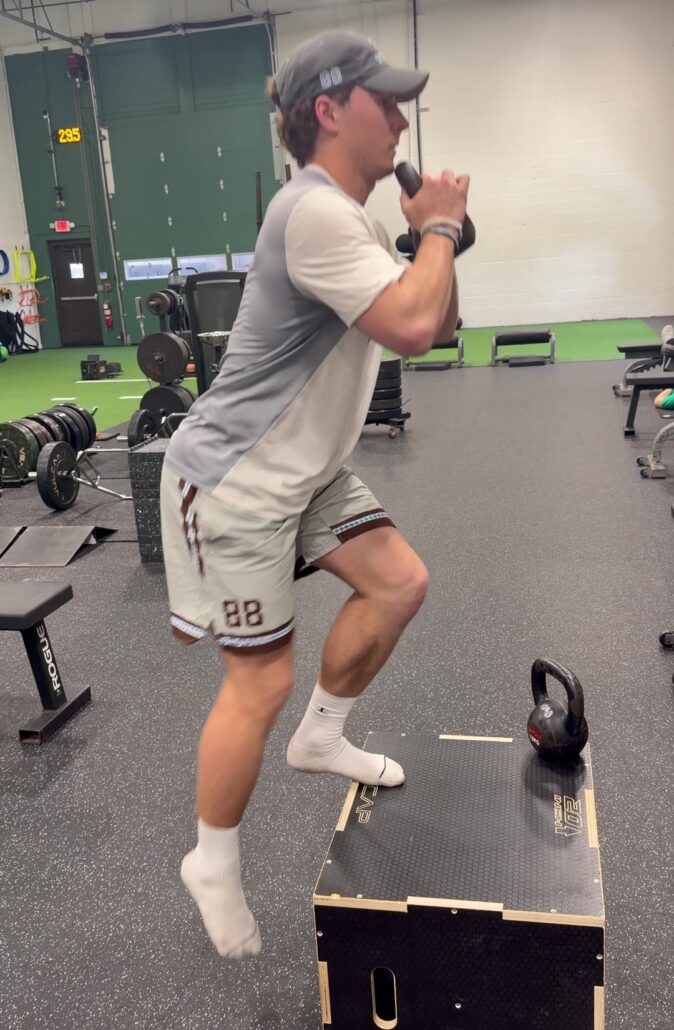
Step ups are another one I lean on a lot. You’re loading one leg at a time, and the height of the box controls how much the knee bends. Start with a lower box if the knee is cranky and work up from there.
I also think we forget how much load running and jumping put through the patellofemoral joint. Mike made this point too. Nobody blinks when a runner with knee pain keeps running a little, but a squat gets banned. If we want these athletes back to running and jumping, they need a knee that can handle load.
And talk to your patients. Explain why you’re changing the squat and how you’ll build it back up. That goes a long way in taking away the fear.
If you want to go deeper on evaluating and treating patellofemoral pain, Mike and I cover it in our Knee Evaluation and Treatment course, along with the rest of the knee.
What I take away about squatting with patellofemoral pain
- Modify before you stop
- Pick the right squat for the knee in front of you. Hip dominant squats are easier on the patellofemoral joint than knee dominant ones
- Keep in mind, hip dominant squats are going to load the quads less, but they take some stress off the knee
- Use range, load and tempo as your dials
- Small cues can change patellofemoral load
- Pain around 1 or 2 out of 10 that doesn’t build is usually ok
- Build back toward full depth and load over time
- Explain the plan so your patient isn’t afraid to squat
You can listen to the full episode above or right here on Mike’s site. For more on the knee, check out my knee rehab posts.
References
- Wallace DA, Salem GJ, Salinas R, Powers CM. Patellofemoral joint kinetics while squatting with and without an external load. J Orthop Sports Phys Ther. 2002;32(4):141-148. doi.org/10.2519/jospt.2002.32.4.141
- Escamilla RF, Fleisig GS, Zheng N, et al. Biomechanics of the knee during closed kinetic chain and open kinetic chain exercises. Med Sci Sports Exerc. 1998;30(4):556-569. doi.org/10.1097/00005768-199804000-00014
- Ishida T, Ueno R, Kitamura Y, et al. The effect of real-time feedback regarding the center-of-pressure position on patellofemoral joint loading during double-leg squatting. Orthop J Sports Med. 2025;13(3):23259671251319526. doi.org/10.1177/23259671251319526
- Crossley KM, van Middelkoop M, Callaghan MJ, et al. 2016 Patellofemoral pain consensus statement from the 4th International Patellofemoral Pain Research Retreat, Manchester. Part 2: recommended physical interventions. Br J Sports Med. 2016;50(14):844-852. doi.org/10.1136/bjsports-2016-096268
Want to go deeper on the knee? This is the online course I teach with Mike Reinold. ACL, patellofemoral pain, meniscus, progressive loading and return to sport.
Enroll Now →
Evidence based sports rehab content, course updates and clinical pearls. No spam.
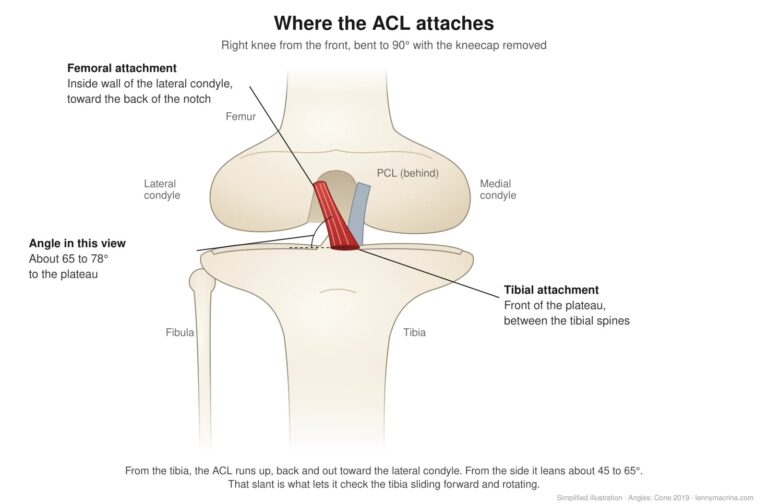
ACL Anatomy: 5 Things Rehab Clinicians Should Know
What the research says about ACL anatomy: its size and shape, the two bundles, the flat ribbon, nerves and blood supply, and why it matters for ACL rehab.
Read Post →
ACL Reconstruction With an LET: What Changes in Rehab?
More ACL patients are getting a lateral extra-articular tenodesis (LET), even with patellar and quad tendon grafts. What the research says and what changes in rehab.
Read Post →
What Actually Changes After ACL Surgery
A study tracked 30 athletes at 3, 6, 9 and 12 months after ACL reconstruction. Here is what changed, and why symmetry alone does not mean ready.
Read Post →